
Fuzzy Time Series K-Medoids for Inflation Forecasting in West Sulawesi Province
Bilah Samping Artikel
Isi Artikel Utama
Abstrak
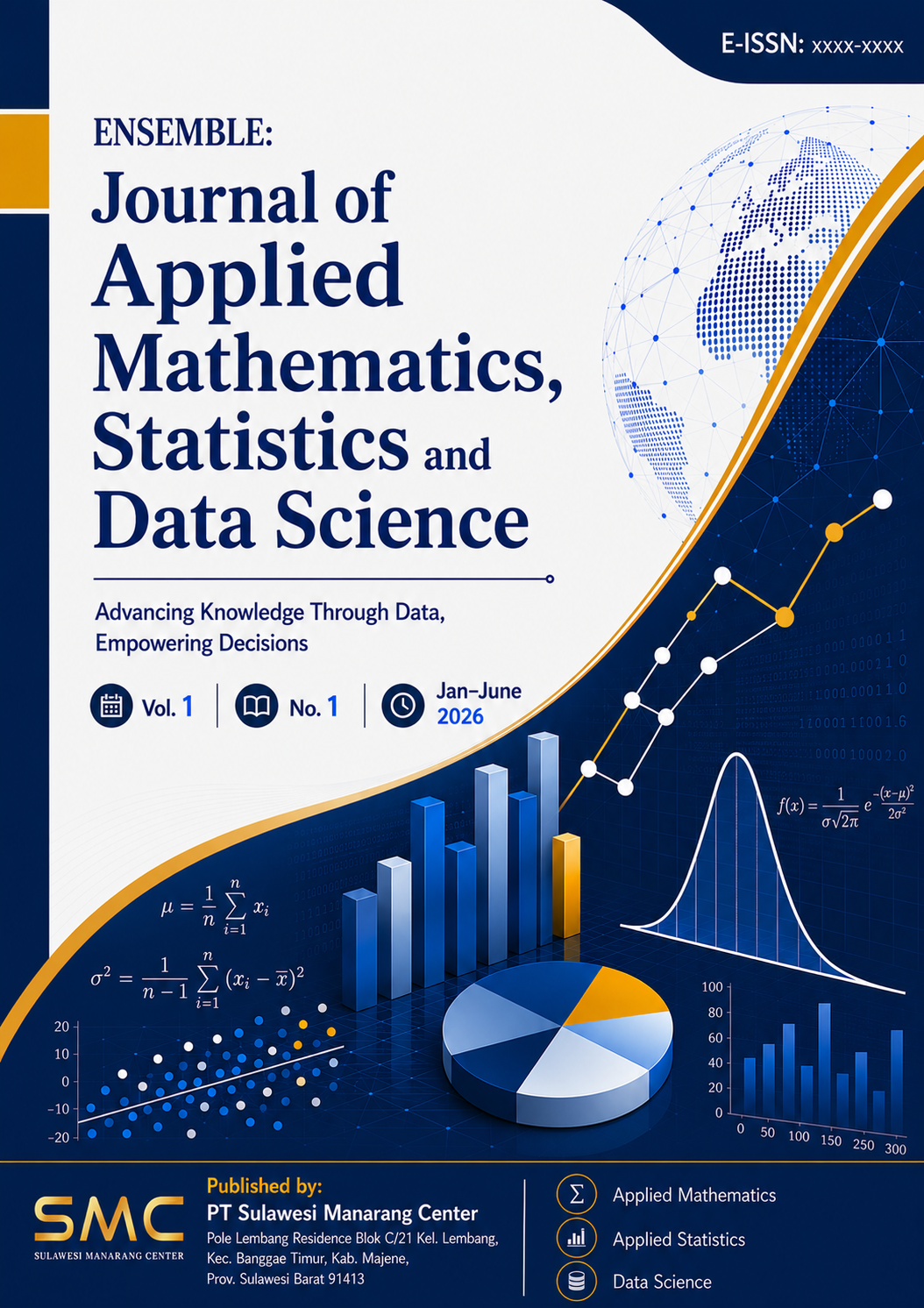
Inflation is a key indicator of macroeconomic that reflects the price stability of a region and directly influences purchasing power, business planning, and public policy. West Sulawesi, an agriculture- and fishery-dependent province, exhibits a highly fluctuating monthly inflation pattern that is difficult to capture with conventional linear forecasting models. This study proposes a Fuzzy Time Series (FTS) model combined with K-Medoids clustering to forecast monthly inflation in West Sulawesi Province using Statistics Indonesia (BPS) data from January 2019 to December 2024 (72 observations). K-Medoids clustering, initialized using the optimal number of clusters selected via the Pseudo-F statistic and validated with the Silhouette Coefficient, was used to partition the historical data into representative intervals prior to fuzzification. Fuzzy Logical Relationships (FLR) and Fuzzy Logical Relationship Groups (FLRG) were then constructed to model the transition pattern between fuzzy states, and defuzzification was performed to generate numerical forecasts. Model accuracy was evaluated using Mean Absolute Error (MAE), Mean Squared Error (MSE), and Mean Absolute Percentage Error (MAPE). The optimal number of clusters was found to be k = 7, supported by the highest Pseudo-F value (325.28) and Silhouette Coefficient (0.574). The FTS K-Medoids model achieved an MAE of 0.33, an MSE of 0.18, and a MAPE of 1.45%, corresponding to a forecasting accuracy of 98.55%, which falls into the “very good” category. The out-of-sample forecast for January 2025 was 0.253%, indicating a stable and controlled inflation outlook. These results demonstrate that the FTS K-Medoids approach is an effective, distribution-free alternative for forecasting nonlinear and volatile regional inflation data
##plugins.themes.bootstrap3.displayStats.downloads##
Rincian Artikel
Bagian
Cara Mengutip
Referensi
S. Amir, Fadilla, and P. Anggun, “Pengaruh inflasi terhadap pertumbuhan ekonomi Indonesia,” Ekonomica Sharia, vol. 7, no. 1, pp. 17–28, 2021.
F. F. Aulia and A. Defri, “Implementasi fuzzy time series logika Lee untuk peramalan inflasi di Indonesia,” J. Ilm. Pendidik. Mat. Stat., vol. 4, no. 2, pp. 1083–1092, 2023.
BPS, “Inflasi Sulawesi Barat Juni 2024 capai 2.32 persen,” Badan Pusat Statistik Provinsi Sulawesi Barat, 2024.
H. Dedy, Wanayumini, and S. D. Irfan, “Pengelompokan algoritma K-Means dan K-Medoid berdasarkan lokasi daerah rawan bencana di Indonesia dengan optimasi Elbow, DBI, dan Silhouette,” Build. Informatics Technol. Sci., vol. 6, no. 2, pp. 1151–1158, 2024.
R. A. Farissa, R. Mayasari, and Y. Umaidah, “Perbandingan algoritma K-Means dan K-Medoids untuk pengelompokkan data obat dengan Silhouette Coefficient,” J. Appl. Informatics Comput., vol. 5, no. 2, pp. 109–116, 2021.
A. D. Florencia and N. Lilis, “Implementasi metode fuzzy time series dalam peramalan penjualan produk unggulan perusahaan,” JUTIN, vol. 7, no. 1, pp. 176–185, 2024.
H. Gabriella and Matdoan, “Algoritma K-Medoids clustering untuk mengelompokkan tingkat kemiskinan pada kabupaten dan kota di Kepulauan Maluku dan Papua,” J. Stat. Its Appl., vol. 4, no. 2, pp. 81–87, 2022.
R. A. Mella and A. Ulil, “Optimasi portofolio saham menggunakan model mean-variance dan mean absolute deviation berdasarkan K-Medoids clustering,” J. Mat. Stat. Komputasi, pp. 164–183, 2023.
I. A. Putri, N. El Maidah, and M. A. Furqon, “Penerapan metode fuzzy time series Cheng pada peramalan inflasi di Indonesia,” Komputika J. Sist. Komput., vol. 13, no. 2, pp. 183–191, 2024.
A. N. Rais et al., “Evaluasi metode forecasting pada data kunjungan wisatawan mancanegara ke Indonesia,” EVOLUSI J. Sains Manaj., vol. 8, no. 2, pp. 104–115, 2020.
N. A. Siagian, A. Rikki, and P. B. N. Simangunsong, “Clustering menggunakan metode K-Medoids dengan pendekatan Manhattan distance,” KAKIFIKOM, pp. 169–175, 2023.
Q. Song and B. S. Chissom, “Fuzzy time series and its models,” Fuzzy Sets Syst., vol. 54, no. 3, pp. 269–277, 1993.
V. Vita, M. Shantika, and I. Nurfitri, “Penerapan fuzzy time series Chen average based,” Bul. Ilm. Mat. Stat. Terapannya, vol. 10, no. 4, pp. 485–494, 2021.
W. Wardani, “Analisis fluktuasi inflasi pertanian di Indonesia,” J. Agribus. Sci., vol. 3, no. 2, pp. 100–104, 2020.